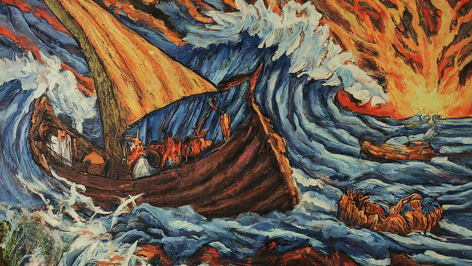
Acts 27 is one of the longest and certainly the most dramatic episode in Acts. Luke has taken us aboard ships with Paul before, but never in this kind of detail or excitement. There’s a raging storm. The ship drifts off-course. It runs aground on a sandbar, with waves breaking it to pieces.
Everyone onboard has to jump ship, grab driftwood, and float to safety. Miraculously, everyone is saved. But no sooner have they come ashore than Paul is bitten by a poisonous viper. But he’s saved that attack too.
It’s another way of declaring Paul’s innocence. Apart from the Sanhedrin, all the judges declare him innocent. Now God Himself adds His verdict. If Paul can survive storm, shipwreck, and snakebite, he’s not guilty before the court of God.
But there’s more happening here. After all, the sea has multiple symbolic associations in the Bible, and the story of Acts 27 is an allegory of what’s to come in Rome.
Politically, the sea signifies the raging, churning world of the nations. Israel is the stable land, but the Gentiles are the sea that regularly threatens the land. Gentile kings and emperors are symbolized by sea monsters, and great empires are portrayed as ships that master the waves.
Yet Yahweh is Lord also of the sea. He rebukes the nations. He throws political storms from heaven, then calms them.
That’s the background of Paul’s sea voyage in Acts 27. The ship is the ship of the Roman state. This time, he’s on a ship carrying grain from Egypt to Rome. He’s under care of a chiliarch named Julius who is of the Augustan cohort. The ship runs into a storm at sea, an apocalyptic storm that blots out the sun and stars and eventually breaks the ship to pieces.
It’s a preview of what’s coming for Rome. With Nero on the imperial throne, the empire is about to be shaken. Stars will fall from the sky. Its ship will be broken. But there’s good news: Paul is onboard.
Paul takes over the ship. He warns against leaving during the winter. He assures the ship’s owner and skipper that none will be lost. He encourages the men, and keeps the soldiers from killing the prisoners. As Paul says, all on the ship have been “granted” to him.
Paul is baptized in the death-waters of the sea, and rises again. With Paul onboard, the Roman passengers are baptized and raised. Rome too will be baptized. Rome will be shattered, but Rome will rise again, renewed.
We don’t need to see Paul before Nero or Paul’s martyrdom. Luke has already told us the ultimate outcome. From the beginning, Paul has witnessed to receptive Gentile kings and governors. It will bear fruit, and eventually the empire will bow to the Christ Paul preaches.
The Bible isn’t an apolitical book. Far from it. God is deeply concerned about nations. But the political future of nations doesn’t depend on policy or military power. It depends on their response to Jesus. Nations may be shipwrecked but their passengers will be saved.
The mission of Jesus is to make disciples of nations, baptizing and teaching them. Nations sink in the storms of time, but those who hear the apostles will be saved. And the kingdoms of this world become the kingdoms of our Lord and of His Christ.
 Immanuel Reformed Church
Leave a comment